⚗️ Density Calculator
Calculate density (ρ), mass (m), or volume (V) using the density equation ρ = m/V. Simply enter any two values to find the third.
🔬 Density Equation Calculator
📊 Density of Common Materials
| Material | Density (kg/m³) | Density (g/cm³) |
|---|---|---|
| Air (at sea level) | 1.2 | 0.001 |
| Water (at STP) | 1,000 | 1.00 |
| Ice | 917 | 0.917 |
| Aluminum | 2,700 | 2.70 |
| Concrete | 2,400 | 2.40 |
| Iron | 7,874 | 7.87 |
| Copper | 8,950 | 8.95 |
| Silver | 10,490 | 10.49 |
| Lead | 11,340 | 11.34 |
| Gold | 19,300 | 19.30 |
| Platinum | 21,450 | 21.45 |
🧪 Understanding Density
The density of a material, typically denoted using the Greek symbol ρ (rho), is defined as its mass per unit volume. It is a fundamental physical property that describes how much matter is packed into a given space.
📐 The Density Formula
- ρ (rho) = density
- m = mass
- V = volume
🌡️ Factors Affecting Density
- Temperature: Usually decreases density as volume expands
- Pressure: Increases density by compressing volume
- Phase: Solids typically denser than liquids than gases
- Composition: Different materials have different atomic structures
📏 Common Density Units
| Unit | Conversion to kg/m³ |
|---|---|
| kilogram/cubic meter (kg/m³) | SI Unit (base) |
| gram/cubic centimeter (g/cm³) | × 1,000 |
| kilogram/liter (kg/L) | × 1,000 |
| gram/liter (g/L) | × 1 |
| pound/cubic foot (lb/ft³) | × 16.02 |
| pound/cubic inch (lb/in³) | × 27,680 |
Density Formula, Units, and Material Assumptions
Density is a measure of how much mass is contained in a given volume. It's important because it helps us identify materials, predict whether objects will float or sink, and is crucial in fields like engineering, chemistry, and physics. For example, ships float because their overall density is less than water.
Temperature and pressure significantly affect density, especially in gases. Increasing pressure decreases volume and thus increases density. Increasing temperature usually increases volume and decreases density (water between 0°C and 4°C is an exception). For solids and liquids, these effects are typically smaller but still measurable.
Ice floats on water because it is less dense than liquid water. Water is unusual in that its solid form (ice) is less dense than its liquid form. Ice has a density of about 917 kg/m³, while liquid water has a density of 1,000 kg/m³ at 4°C. This happens because water molecules form a crystal structure with more space between them when frozen.
Among common materials, osmium and iridium are the densest elements at about 22,600 kg/m³. Gold (19,300 kg/m³) and platinum (21,450 kg/m³) are also very dense. At the other end, hydrogen gas is one of the least dense materials at about 0.09 kg/m³ at sea level. Aerogels can be even less dense, with some as low as 1-2 kg/m³.
The accuracy of density calculations depends on the precision of your mass and volume measurements. Always use the same level of precision for all measurements and be aware of significant figures. This calculator provides theoretical results; real-world measurements may vary due to factors like temperature, pressure, impurities, and measurement equipment limitations.
Specific gravity is the ratio of a substance's density to the density of a reference substance (usually water at 4°C). It's a dimensionless number that makes it easy to compare densities. For example, a specific gravity of 2.0 means the substance is twice as dense as water. Specific gravity is often used in industries like brewing, petroleum, and gemology.
Related Tools
Useful tools selected for this workflow
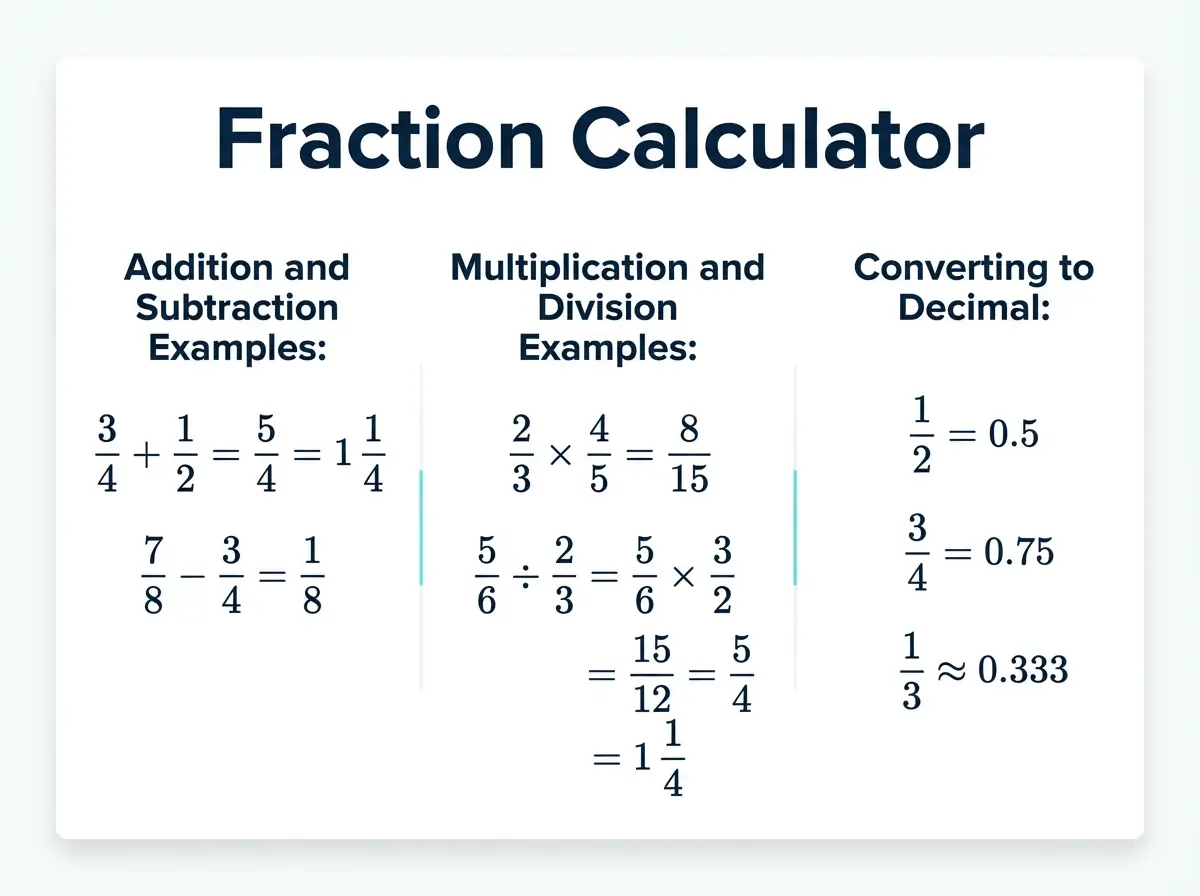
Fraction Calculator
Add, subtract, multiply, and divide fractions. Simplify fractions, convert decimals, and work with mixed numbers easily.
Pythagorean Theorem Calculator
Calculate the missing side of a right triangle using the Pythagorean theorem (a² + b² = c²). Free online calculator with step-by-step solutions.
Average Calculator
Calculate the average, sum, count, median, mode, range, minimum, maximum, and weighted average for a list of numbers.
LCM Calculator
Find the least common multiple of two or more integers with exact BigInt results, GCF, prime factorization, formulas, and calculation steps.
Ratio Calculator
Solve A:B = C:D, find missing ratio values, simplify equivalent ratios, scale proportions, calculate percentages, and view ratio diagrams.
Distance Formula Calculator
Find exact and decimal distances between two points in 2D or 3D with coordinate differences, midpoint, and step-by-step formulas.