1
Find the GCF
Use the Euclidean algorithm to find the greatest common factor of the first two integers.
Find the least common multiple of two or more integers with exact results, GCF, prime factorization, and step-by-step calculations.
Highest required prime powers give LCM = 4,950.
The least common multiple is the smallest positive integer divisible by every number in the set. For two non-zero integers, the fastest manual formula uses their greatest common factor.
Use the Euclidean algorithm to find the greatest common factor of the first two integers.
Divide one integer by the GCF before multiplying by the other. This produces their LCM.
Use the result with the next integer and continue until every input has been included.
GCF(18, 26) = 2, so LCM(18, 26) = (18 ÷ 2) × 26 = 234.
There are three common ways to calculate the LCM. They produce the same answer, but each is useful in a different situation.
12: 12, 24, 36…
List multiples of each number until the first shared value appears. It is intuitive for small integers but becomes slow quickly.
LCM = product of highest prime powers
Factor each integer and select the greatest exponent of every prime. This clearly shows why the result is divisible by all inputs.
LCM(a,b) = |a×b| ÷ GCF(a,b)
Use the Euclidean algorithm for the GCF, then apply the product formula pairwise. This is efficient even for large integers.
| Numbers | GCF | LCM | Check |
|---|---|---|---|
| 8, 12 | 4 | 24 | 24 ÷ 8 = 3; 24 ÷ 12 = 2 |
| 18, 26 | 2 | 234 | 234 ÷ 18 = 13; 234 ÷ 26 = 9 |
| 21, 14, 38 | 1 | 798 | 798 is divisible by all three |
| 4, 6, 8 | 2 | 24 | 24 is the first shared multiple |
Find the least common denominator needed to add or subtract fractions.
Determine when events with different repeat intervals occur together again.
Align machine cycles, gear rotations, signals, or periodic processes.
Find the smallest quantity that can be arranged evenly into several group sizes.
The least common multiple (LCM) is the smallest positive integer divisible by every number in a set. For example, the LCM of 4 and 6 is 12.
Find the GCF of two numbers, divide one number by the GCF, then multiply by the other number: LCM(a,b) = |a × b| ÷ GCF(a,b). Repeat pairwise for more than two numbers.
Write each number as a product of primes. Take every prime that appears, using its highest exponent, then multiply those prime powers. For 12 = 2²×3 and 18 = 2×3², LCM = 2²×3² = 36.
Calculate pairwise: first find LCM(a,b), then find the LCM of that result and c. Continue until every number has been included. The order does not change the final result.
The LCM is the smallest positive shared multiple, while the GCF or GCD is the largest positive shared divisor. For two non-zero integers, LCM × GCF = |a × b|.
The LCM of 0 and any integer is 0, because there is no positive multiple of 0. The calculator follows this standard convention.
Yes. Divisibility and multiples are determined from absolute values, so LCM(−4, 6) is the same as LCM(4, 6), which is 12.
LCM is normally defined for integers. Convert decimals or fractions to whole-number ratios first, or clear their denominators before calculating the integer LCM.
A calculator of LCM quickly finds when repeating intervals align, creates common denominators for fractions, and solves grouping or scheduling problems involving multiple cycles.
Yes. This LCM of calculator uses exact BigInt arithmetic for inputs up to 100 digits, so results do not lose precision like ordinary floating-point calculations.
Find the LCM of the denominators and use it as the least common denominator. Convert each fraction to that denominator, then add or subtract the numerators.
When every input is non-zero, the LCM is at least as large as the largest absolute input, but it may equal one input when all other numbers divide it exactly. For example, LCM(4, 8) = 8. If any input is zero, the LCM is zero.
Useful tools selected for this workflow
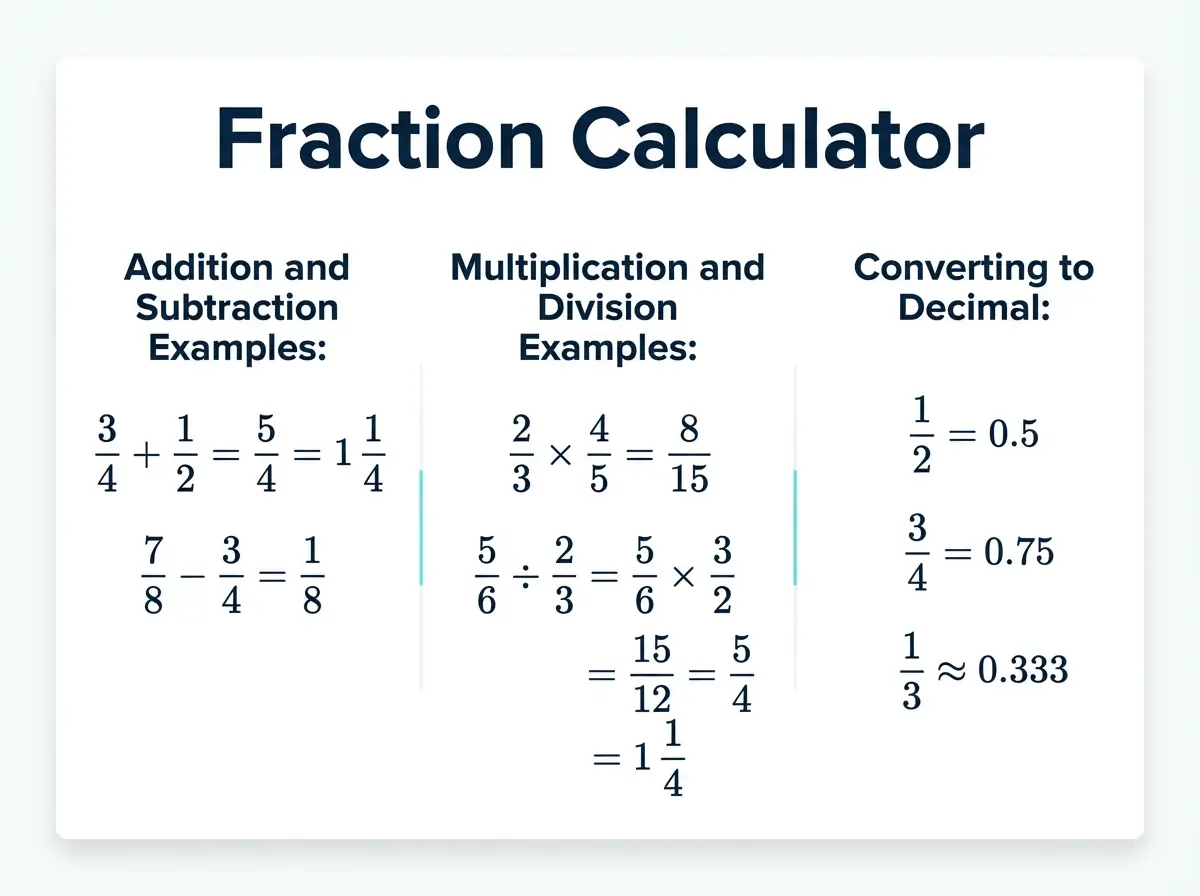
Add, subtract, multiply, and divide fractions. Simplify fractions, convert decimals, and work with mixed numbers easily.
Calculate the missing side of a right triangle using the Pythagorean theorem (a² + b² = c²). Free online calculator with step-by-step solutions.
Calculate the average, sum, count, median, mode, range, minimum, maximum, and weighted average for a list of numbers.
Solve A:B = C:D, find missing ratio values, simplify equivalent ratios, scale proportions, calculate percentages, and view ratio diagrams.

Find exact and decimal distances between two points in 2D or 3D with coordinate differences, midpoint, and step-by-step formulas.

Evaluate mathematical expressions with this free online tool. Perfect for solving complex equations, calculating values, and more.