🪵 Flooring & Carpet
Measure every room, subtract permanent exclusions when appropriate, then add 5–15% for cuts, matching patterns, and future repairs.
Calculate square footage for rooms, walls, lots, gardens, flooring, and construction projects. Choose a shape, mix measurement units, add quantity and waste, then estimate material cost.
Square footage measures two-dimensional area in square feet. For a rectangle, convert the length and width to feet and multiply them. If a room or lot is irregular, divide it into rectangles, triangles, circles, or other simple sections, calculate each area, and add the results.
The calculator converts each measurement independently, so a length entered in feet can be paired with a width entered in inches, yards, meters, or centimeters. Quantity multiplies the selected shape, while the waste factor adds material allowance for cuts, breakage, seams, and installation errors.
Measure the dimensions at their widest relevant points and record each unit accurately.
Apply the matching area formula, then multiply by the number of identical areas.
Add a practical waste percentage and multiply by the material price per square unit.
| Shape | Area Formula | Typical Use |
|---|---|---|
| Rectangle / Square | L × W | Rooms, floors, lots |
| Rectangle Border | (L + 2b)(W + 2b) − LW | Borders, frames, paths |
| Circle | πr² | Round patios, tables |
| Ring / Annulus | π(R² − r²) | Circular borders, tracks |
| Triangle (3 sides) | √[s(s−a)(s−b)(s−c)] | Irregular triangular sections |
| Triangle (base/height) | ½bh | Gables, simple triangles |
| Trapezoid | ½(a + b)h | Sloped lots, wall sections |
| Sector | (θ/360)πr² | Curved beds, fan shapes |
| Parallelogram | bh | Slanted panels, lots |
| Wall minus opening | Wall − Opening | Paint, siding, wallpaper |
| Cathedral wall | ½w(h₁ + h₂) | Sloped ceiling walls |
Measure every room, subtract permanent exclusions when appropriate, then add 5–15% for cuts, matching patterns, and future repairs.
Calculate wall area, subtract doors and windows, and divide by the product coverage rate. Primer often has a different coverage rate than paint.
Use total adjusted square footage to estimate tile, backer board, wall panels, ceiling panels, or sheet materials.
Measure lawns, gardens, patios, paths, and circular beds before ordering sod, seed, pavers, or landscape fabric.
Square footage supports early comparisons for construction, roofing, siding, and finish materials, though labor and design can change final cost.
Multiply the adjusted area by a quoted price per square foot, yard, meter, inch, or acre to compare material options consistently.
Simple rectangular layouts with repeatable cuts and reliable measurements.
A common allowance for flooring, tile, carpet, and wall covering projects.
Diagonal patterns, irregular rooms, natural materials, or projects with many corners.
For a rectangle, measure length and width in feet and multiply them: square feet = length × width. For other shapes, choose the matching formula in the calculator. Convert mixed units before multiplying, or let this tool convert each measurement automatically.
Split the room into simple rectangles, triangles, circles, or trapezoids. Calculate each section separately, then add the areas. For an L-shaped room, two rectangles are usually enough.
One acre equals 43,560 square feet. It also equals 4,840 square yards or approximately 4,046.856 square meters.
Multiply square meters by 10.7639. To convert square feet to square meters, multiply by 0.09290304.
A 10% waste factor is common for straightforward flooring and tile installations. Use 5% for very simple layouts and 15% or more for diagonal patterns, irregular spaces, fragile material, or complex cuts.
Include closets when the project material continues through them, such as carpet or flooring. Exclude areas that will not receive the material, such as fixed cabinets or open stair voids, according to your project plan.
Multiply the total adjusted square footage by the material price per square foot. If the supplier quotes another area unit, select that unit beside the price and the calculator will convert the total before estimating cost.
Yes. Choose Wall Minus Opening, enter the full wall dimensions, then enter the combined opening dimensions. For several different openings, calculate their areas separately and subtract the combined total.
Square feet measure two-dimensional area, while linear feet measure one-dimensional length. A 10 ft by 8 ft wall is 80 square feet but has a 36-linear-foot perimeter.
Useful tools selected for this workflow
Calculate the volume of concrete needed for your project. Perfect for calculating the volume of concrete needed for your project.
Calculate tire dimensions, compare tire sizes, and understand tire codes. Free online tire size calculator with diameter, circumference, and speedometer calibration.

Calculate BTU requirements for heating and cooling. Estimate AC BTU needs for rooms and houses based on size, insulation, climate, and other factors.
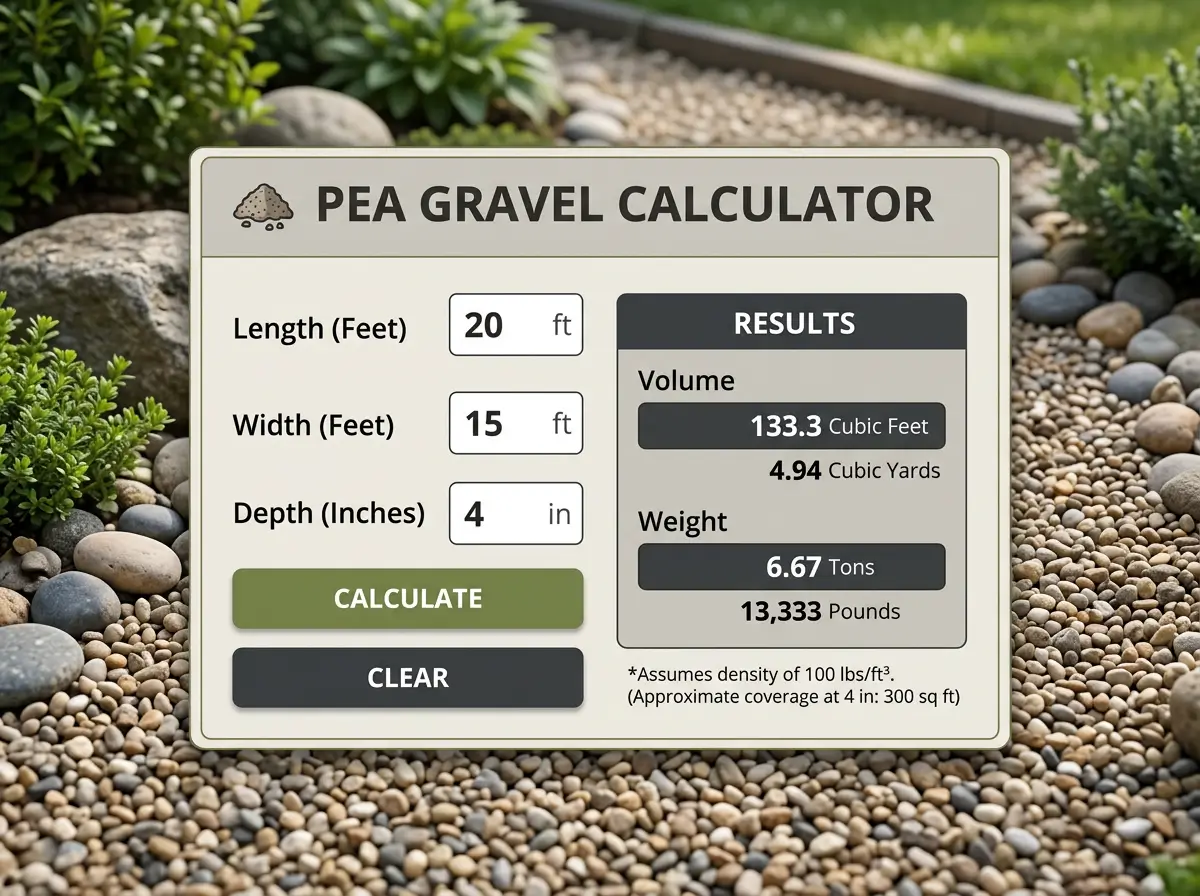
Free pea gravel calculator — estimate how much pea gravel you need by area and depth. Get instant results in cubic yards, cubic feet, tons, lbs, kg, and 50-lb bags. Supports rectangle, circle, and custom area input with optional cost estimate.

Estimate your trip's fuel cost based on distance, fuel efficiency, and gas price. Supports miles, km, MPG, L/100km, km/L, per gallon, and per liter. Includes round-trip mode and vehicle presets.
Free gravel calculator — estimate how much gravel you need by area and depth. Instant results in cubic yards, cubic feet, tons, lbs, kg, and bags. Supports rectangle, circle, and total-area input with material density presets and optional cost.